EU AI Act Roles Explained: Provider, Deployer, Importer, Distributor - and Who Owes What

The same AI system. Four possible roles. Wildly different compliance burdens.
That is the central design choice of the EU AI Act. Your obligations are not determined by the technology - they are determined by your position in the supply chain. A company that builds and brands a high-risk AI system faces more than a dozen mandatory requirements. A company that simply buys and uses that same system faces a much shorter list. And a company that white-labels it or substantially modifies it can silently inherit every obligation the original builder had.
Getting your role wrong is not a paperwork problem. It is a fines problem.
The Four Roles Defined in Article 3
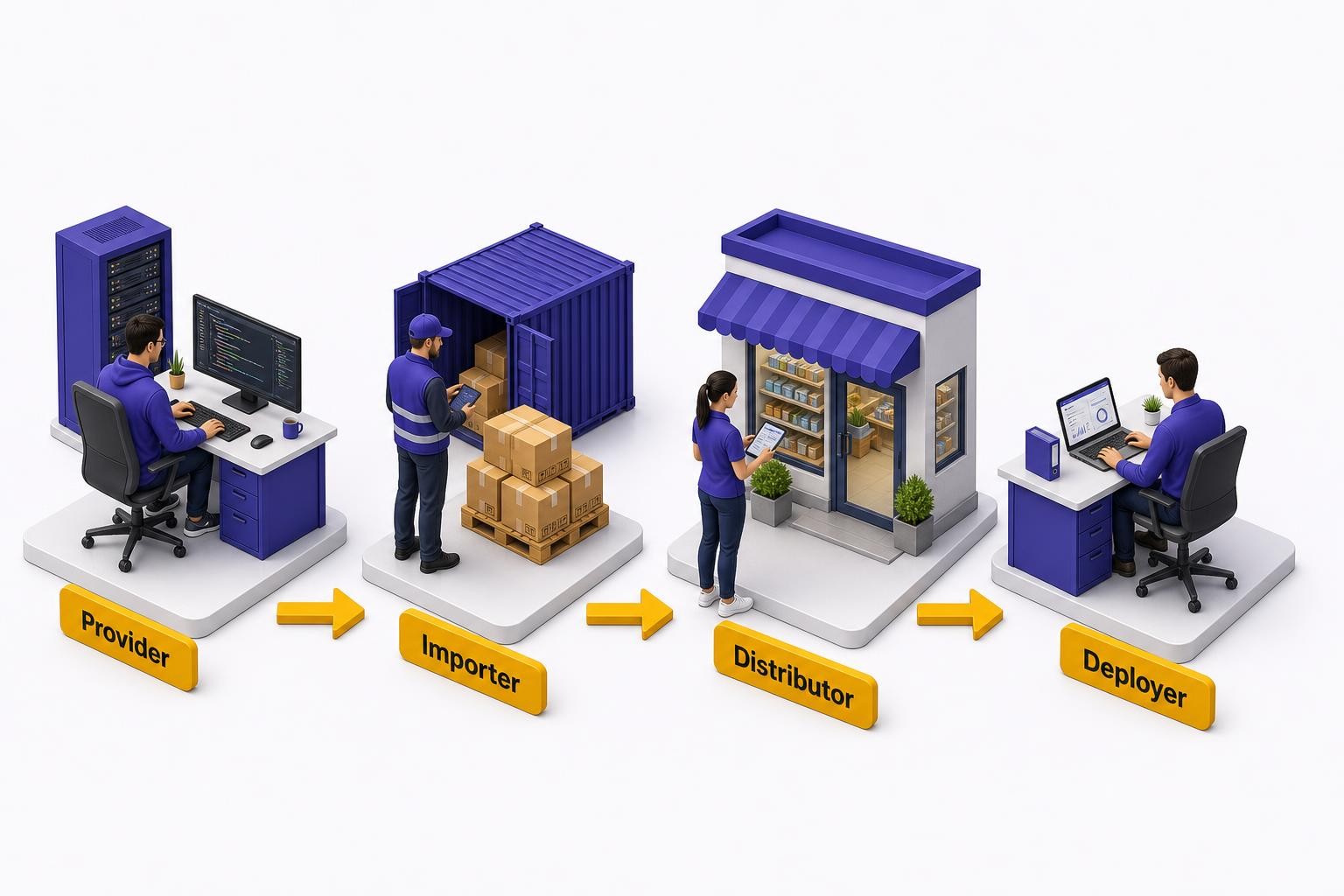
The Act defines four roles that matter for compliance. Every organisation touching an AI system should identify which one applies to each system it builds, buys, or sells.
Provider - develops an AI system (or has one developed), places it on the market, or puts it into service under its own name or trademark. This is the role with the heaviest obligations. Non-EU providers must appoint an EU-based authorised representative under Article 22.
Deployer - uses an AI system under its own authority in a professional context. Deployers do not build the system; they operate it. Personal, non-professional use falls outside the definition entirely.
Importer - an EU-established entity that places on the EU market an AI system bearing the name or trademark of a non-EU provider. Importers sit between the foreign provider and the EU market.
Distributor - any other entity in the supply chain (other than the provider or importer) that makes an AI system available on the EU market without placing it under their own name.
High-Risk AI: Provider vs. Deployer Obligations Side by Side
For high-risk AI systems - those listed in Annex III, such as CV-screening tools, credit-scoring systems, biometric identification, and critical infrastructure management - the gap between provider and deployer duties is substantial.
| Obligation | High-Risk Provider | High-Risk Deployer |
|---|---|---|
| Risk management system | ✅ Art. 9 — continuous lifecycle process required | ❌ Not required |
| Data governance | ✅ Art. 10 — training/validation/test data practices | ❌ Not required |
| Technical documentation (Annex IV) | ✅ Art. 11 — full Annex IV dossier | ❌ Not required |
| Automatic logging / record-keeping | ✅ Art. 12 — logging capability built into system | ✅ Art. 26 — keep logs ≥ 6 months |
| Instructions for use / transparency | ✅ Art. 13 — must provide to deployers | ✅ Art. 26 — must use per instructions |
| Human oversight measures | ✅ Art. 14 — design oversight into the system | ✅ Art. 26 — implement oversight in operation |
| Accuracy, robustness & cybersecurity | ✅ Art. 15 — technical requirements on the system | ❌ Not required |
| Quality management system | ✅ Art. 17 — documented QMS | ❌ Not required |
| Conformity assessment | ✅ Art. 43 — third-party or self-assessment | ❌ Not required |
| CE marking + EU declaration of conformity | ✅ Arts. 47–48 | ❌ Not required |
| Registration in EU database | ✅ Art. 49 | ✅ Art. 49 (for certain Annex III uses) |
| Post-market monitoring | ✅ Arts. 72–73 — proactive monitoring plan | ✅ Art. 26 — monitor, report serious incidents |
| Inform workers & affected persons | ❌ Not a provider duty | ✅ Art. 26 — notify workers and individuals |
| Representative input data | ❌ Not a provider duty | ✅ Art. 26 — ensure data is representative |
| Fundamental Rights Impact Assessment | ❌ Not required | ✅ Art. 27 — public bodies, credit-scoring & insurance deployers |
| Authorised representative (non-EU only) | ✅ Art. 22 — mandatory for non-EU providers | ❌ Not required |
What deployers actually owe under Article 26
Deployer duties are real - just narrower. Under Article 26, a deployer of a high-risk system must:
- Use the system only in accordance with the provider's instructions for use
- Assign human oversight to competent, trained individuals
- Ensure input data is relevant and sufficiently representative for the intended purpose
- Monitor the system's operation and report serious incidents to the provider and market surveillance authority
- Retain automatically generated logs for at least six months
- Inform workers whose tasks are affected, and notify individuals subject to AI-assisted decisions
The Fundamental Rights Impact Assessment (Article 27)
One deployer obligation deserves special attention. Prior to deploying a high-risk AI system, deployers that are bodies governed by public law, or are private entities providing public services, and deployers of high-risk AI systems in the areas of credit scoring and life/health insurance pricing, must perform an assessment of the impact on fundamental rights that the use of such system may produce.
The FRIA is not a one-off tick-box. The obligation applies to the first use of the high-risk AI system, though the deployer may rely on previously conducted assessments or existing assessments carried out by the provider. If, during use, the deployer considers that any element has changed or is no longer up to date, they must take steps to update the information.
Article 27 requires public bodies and credit-scoring/insurance deployers to complete a Fundamental Rights Impact Assessment before first use of a high-risk AI system.
The Role-Shift Trap: Article 25 Reclassification
This is the provision that catches organisations off guard.
The three Article 25(1) triggers under which distributors, importers, deployers, or other third parties step into full provider obligations are: putting their name or trademark on a high-risk system already on the market; making a substantial modification while it remains high-risk; or changing the intended purpose of a system so that it becomes high-risk under Article 6.
In plain terms:
- White-labelling a third-party high-risk AI system under your brand -> you are now the provider.
- Substantially modifying a high-risk system (changing behaviour, performance, security, or context of use in ways not foreseen in the original conformity assessment) -> you are now the provider.
- Repurposing a non-high-risk system in a way that makes it high-risk -> you are now the provider.
This reclassification is automatic - there is no registration process or notification. If the conditions are met, you are a provider under the law, with all associated obligations, regardless of what the original contract with your vendor says.
Article 25 reclassification is automatic - no notification or registration is required to trigger full provider obligations.
What counts as "substantial modification"?
A "substantial modification" means a change to an AI system after its placing on the market or putting into service which is not foreseen or planned in the initial conformity assessment carried out by the provider and as a result of which the compliance of the AI system with the requirements set out in Chapter III, Section 2 is affected, or results in a modification to the intended purpose for which the AI system has been assessed.
Conversely, routine patching, UI adjustments, parameter tweaking within documented ranges, bug fixes, or modifications expressly foreseen in the technical file do not constitute substantial modification. Nor does it constitute a substantial modification if an AI system continues to learn or adapt automatically after being placed on the market, provided that such developments were foreseen by the provider and assessed during the initial compliance phase.
Fine-tuning an open-source model for production use is a common reclassification risk. If the fine-tuned system is high-risk and the modifications go beyond what the original technical file anticipated, you become the provider — with the full Article 16 obligation stack. Check your exposure with our free Obligations Checker and Risk-Tier Classifier before you deploy.
Importer and Distributor: The Middle-Chain Roles
Importers and distributors carry lighter but still meaningful duties.
Before selling a high-risk AI system, importers must ensure it has passed the necessary conformity assessments, has the correct documentation, and bears the CE marking. If the importer suspects the system does not meet regulations or has fake documentation, they must not sell it until it complies. Importers must also provide their contact details on the system or its packaging and keep a record of its certification and instructions for ten years.
Before distributing a high-risk AI system, distributors must verify it has the CE marking, EU declaration of conformity, and instructions for use, and that providers and importers have met their obligations. If a distributor suspects non-compliance, they must not release the system and must inform the provider or importer. Distributors must ensure proper storage and transport conditions and take corrective actions if they identify issues post-release, informing relevant parties and authorities. They must provide necessary information to authorities upon request and cooperate with them to mitigate risks.
Importers must retain a copy of the notified body certificate, instructions for use, and EU declaration of conformity for ten years after the high-risk AI system is placed on the market.
Critically, importers and distributors can become providers of high-risk AI systems and become subject to full Article 16 obligations where they meet the criteria in Article 25(1). The reclassification rules apply to everyone in the chain, not just deployers.
Quick Decision Guide
Not sure which role applies to you? Use the interactive tool below to work through the key questions.
Key Takeaways
- Role determines obligations - not the technology, not the contract, not the vendor's assurances.
- Providers carry the heaviest load: risk management, data governance, technical documentation, conformity assessment, CE marking, registration, and post-market monitoring.
- Deployers have a shorter list but it is legally binding: use per instructions, human oversight, representative data, log retention (≥ 6 months), worker notification, and - for public bodies and certain financial services - a Fundamental Rights Impact Assessment.
- Article 25 is the hidden trap: rebranding, substantial modification, or purpose-change automatically reclassifies any party as the provider, regardless of contracts.
- Importers and distributors are not passive - they must verify conformity before placing or making systems available, and they too can be reclassified under Article 25.
Not sure which obligations apply to your specific situation? Use our free Obligations Checker to get a role-specific checklist, and the Risk-Tier Classifier to confirm whether your AI system qualifies as high-risk under Annex III — before enforcement deadlines arrive.
Related reading

NIST AI RMF and the EU AI Act: An Honest Crosswalk for US Compliance Teams
NIST AI RMF gives you a 60-70% head start on EU AI Act compliance - and stops dead at the five gaps that carry the fines. Here's the honest function-by-function map, the five gaps, and a 90-day plan.

ISO/IEC 42001 Is Not a Presumption of Conformity Under the EU AI Act - and Neither Is EN 18286:2026 Yet
ISO/IEC 42001 certification is useful AI governance infrastructure - but it is not a presumption of conformity under the EU AI Act. Neither is EN 18286:2026, yet. Here's why, and what to do about it.
The EU AI Act's Notified Body Bottleneck: Why Conformity Assessment Still Isn't Ready
The Digital Omnibus pushed the high-risk AI Act deadline to December 2027 largely because notified bodies and harmonised standards are not ready. Here is the state of the conformity-assessment infrastructure, what still applies on schedule, and how to use the extra runway.