Who Actually Enforces the EU AI Act? A Plain-English Guide to the Enforcement Architecture

If you build or deploy AI systems in the EU, you will eventually receive a letter, a request for documents, or an inspection notice. The question is: from whom?
The EU AI Act does not have a single regulator. It has a layered architecture - EU-level bodies for general-purpose AI (GPAI) models, and national authorities for everything else. Getting the layers wrong is a compliance risk in itself: you could be preparing for the wrong regulator, or failing to identify the authority that actually has jurisdiction over your products.
This guide maps the full enforcement structure in plain English, explains what activates on 2 August 2026, and tells you what to do before that date arrives.
The Two-Track Enforcement Model
The AI Act creates what the European Parliament Research Service (EPRS) calls a "hybrid enforcement model": enforcement is shared between EU Member States and the European Commission, with different bodies responsible for different categories of AI.
The enforcement of the AI Act's rules is shared between EU Member States and the European Commission, resulting in a hybrid enforcement model. At the top sits the European AI Office; below it, each Member State runs its own national competent authorities. The two tracks operate in parallel, not in sequence.
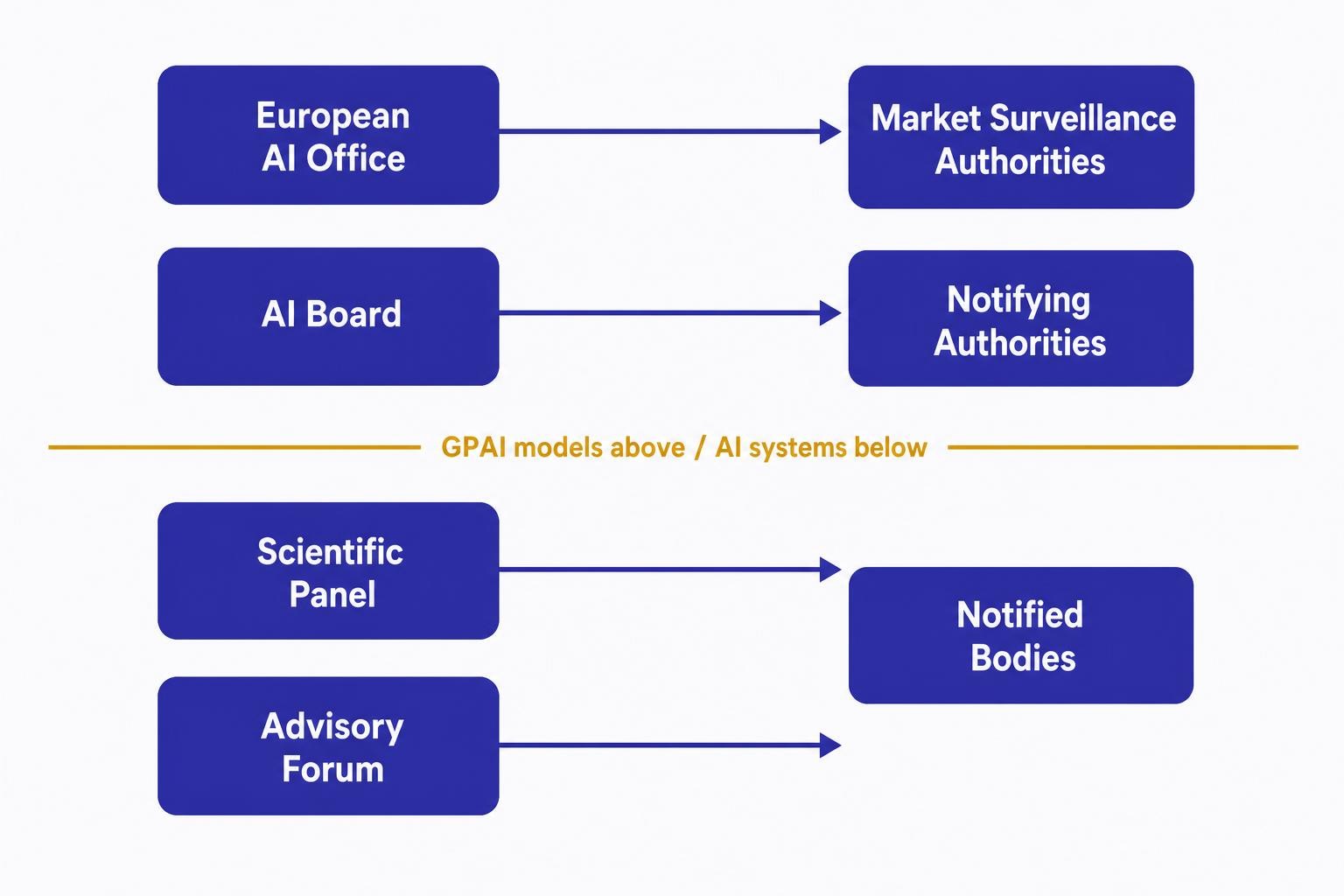
Track 1: EU-Level - The European AI Office and Its Supporting Bodies
The European AI Office
The European AI Office was established within the European Commission as the foundation for a single AI governance system. It supports the EU approach to AI, playing a key role in implementing the AI Act - especially for general-purpose AI (GPAI) - guaranteeing the health, safety and fundamental rights of people and providing legal certainty to businesses. It also enforces the rules for GPAI models and supports the governance bodies in Member States in their tasks.
In practical terms, the AI Office is the regulator you face if you develop a GPAI model - a foundation model, a large language model, or any model that can perform a wide range of tasks. The AI Office is defined by the AI Act as the "Commission's function of contributing to the implementation, monitoring and supervision of AI systems and general-purpose AI models, and AI governance." It has the sole authority to enforce the AI Act provisions on GPAI models.
This is underpinned by the powers given to the Commission by the AI Act, including the ability to conduct evaluations of GPAI models, request information and measures from model providers, and apply sanctions.
On the penalty side, the Commission can fine GPAI providers up to EUR 15 million or 3% of total worldwide annual turnover, whichever is higher, for intentionally or negligently infringing GPAI obligations, failing to comply with information requests, or refusing access for model evaluations. (See our GPAI obligations guide for the full penalty breakdown under Article 101.)
GPAI obligations have applied since 2 August 2025. The Commission's enforcement powers for the most advanced GPAI models activate on 2 August 2026. If you provide a GPAI model, you are already in scope — the enforcement clock is running.
The Three Advisory Bodies
The AI Act's governance is steered by three advisory bodies: the European Artificial Intelligence Board, composed of representatives from the EU Member States; the Scientific Panel, composed of independent experts in the field of AI; and the Advisory Forum, representing a diverse selection of stakeholders, both commercial and non-commercial.
These bodies do not issue fines. Their role is coordination, expertise, and guidance - but they shape how enforcement develops in practice.
The AI Board has as its primary objective to advise and assist Member States and the Commission to ensure the consistent and effective application of the AI Act across the EU. The AI Board's primary role is to ensure the effective implementation of the AI Act across the EU by coordinating national authorities, sharing technical and regulatory expertise and providing advice on AI policy, innovation, and international partnerships.
The Scientific Panel brings together 60 world-leading independent experts with experience in frontier AI, engineering, technical auditing, industry and societal impact. It focuses on general-purpose AI models and systems, systemic risks, model classification, evaluation methodologies and cross-border market surveillance.
The Advisory Forum comprises stakeholders from industry, start-ups, SMEs, civil society and academia. The AI Act tasks the forum with providing technical expertise, advising the board and the Commission and contributing to their tasks under the regulation.
Track 2: National Level - The Authorities That Will Knock on Your Door
For most AI providers and deployers - those building or using AI systems that are not GPAI models - the relevant enforcer is a national authority. The Commission and the AI Office work closely with national competent authorities, who supervise the implementation and application of the AI Act at national level. National competent authorities include market surveillance authorities, which supervise and enforce compliance with the rules for AI systems, including prohibitions and rules for high-risk AI.
Market Surveillance Authorities (MSAs)
The MSA is the authority most compliance teams need to focus on. The market surveillance authority performs ex-post checks once AI systems have been placed on the internal market. Its powers include requesting documents, evaluating systems and imposing fines, if needed.
Market surveillance authorities have the power to intervene when AI systems pose risks or do not comply with the requirements of the AI Act, to conduct remote monitoring, and to access providers' documentation, data sets, and source code. These authorities can propose joint investigations with the Commission, request corrective measures, and enforce the rules through the imposition of penalties.
Each Member State must appoint one or multiple market surveillance authorities. In case of multiple market surveillance authorities, the Member State must designate a Single Point of Contact. That Single Point of Contact is your primary port of call for regulatory correspondence.
A separate authority may be in charge of ex-post checking in certain situations, such as controlling high-risk AI systems for financial institutions or law enforcement. In other words, if your AI system sits in a regulated sector - banking, insurance, healthcare - the sectoral regulator may be the relevant MSA, not a general digital authority.
Notifying Authorities
Notifying authorities designate and supervise notified bodies, which are independent bodies that carry out pre-market conformity assessment. Their role is upstream of enforcement: they accredit the third-party bodies that certify high-risk AI systems before those systems reach the market.
Each Member State shall establish or designate as national competent authorities at least one notifying authority and at least one market surveillance authority for the purposes of this Regulation.
Notified Bodies
Notified bodies are not public authorities - they are accredited independent organisations. Conformity assessment bodies are bodies that perform third-party conformity assessment activities, including testing, certification and inspection. Such third-party assessment applies in certain circumstances to biometric high-risk systems. It also applies to AI systems that are themselves products, or safety components of products, covered by Union harmonisation legislation listed in Annex I, where that legislation already requires the product to undergo a third-party conformity assessment.
If your high-risk AI system falls into these categories, you cannot self-certify. You need a notified body to sign off before you can affix the CE mark. See our conformity assessment guide for the full process.
What Activates on 2 August 2026
2 August 2026 is the date on which full investigatory and enforcement powers transfer to national market surveillance authorities for most AI Act obligations. Article 99 - the penalties framework - becomes applicable for the majority of obligations on that date.
In preparation for 2 August 2026, the AI Office has also established the structures and competencies needed for using enforcement powers. The powers include requesting information, requesting access to a model for evaluations, requiring risk mitigation measures, and issuing fines of up to 3% of global annual turnover or requesting a provider to restrict the making available on the market, withdraw or recall the model.
For national MSAs, the Article 99 penalty structure sets the following ceilings:
- Up to EUR 35 million or 7% of global annual turnover for violations of prohibited AI practices
- Up to EUR 15 million or 3% for most other infringements (including high-risk obligations)
- Up to EUR 7.5 million or 1% for providing incorrect information to authorities
A note on the Digital Omnibus. On 7 May 2026, the European Parliament and the Council of the EU reached a provisional agreement on the Digital Omnibus on AI - a package of targeted amendments to the EU AI Act. Although not yet formally adopted, the agreement provides greater certainty to businesses by signalling that key enforcement deadlines for certain rules relating to high-risk AI systems will be extended.
The deal confirms the postponement of the high-risk obligations to 2 December 2027 (Annex III) and 2 August 2028 (Annex I). On 29 June, the Council of the EU gave its final green light to the AI Act simplification package, following the European Parliament's formal endorsement on 16 June 2026. The Omnibus is expected to be published in the Official Journal and enter into force shortly - but until that happens, the original 2 August 2026 deadline for Annex III high-risk systems remains on the books.
Critically, the Omnibus does not delay GPAI enforcement, transparency obligations under Article 50, or the prohibited practices regime. Those apply on schedule.
The Readiness Gap: Why Patchy National Implementation Matters for You
Each Member State should have designated and empowered national competent authorities by 2 August 2025. Many did not.
Member States had until 2 August 2025 to establish or designate a market surveillance authority and a notifying authority. Many Member States failed to meet the deadline. As of the date that resource was last updated, only 9 Member States had designated both market surveillance and notifying authorities.
Research published ahead of the deadline found the picture even starker: one week prior to the deadline, 21 Member States had not yet submitted a national implementation law to their parliaments to legally enshrine their designations, while 13 had not announced the designation of their national competent authorities.
Progress was fragmented, with many states not having made an announcement about their designation choices, or not legally enshrining their designation decisions.
What this means in practice for cross-border providers:
- Uneven enforcement risk. If your lead market is a Member State with a fully operational, well-resourced MSA, you face a higher near-term enforcement probability than a competitor whose primary market is a state still working through its designation process. This is not a reason to relax - it is a reason to be ready first.
- Jurisdiction uncertainty. For providers selling into multiple Member States, the question of which MSA leads an investigation is not always obvious. To ensure effective market surveillance, MSAs are obliged to share certain information about non-compliance, risk assessments, and enforcement measures with the MSAs of other Member States and the Commission. A finding in one state can trigger scrutiny in others.
- Documentation requests can come early. MSAs do not need to wait for a complaint. Market surveillance authorities have the power to conduct remote monitoring and to access providers' documentation, data sets, and source code. Having your technical documentation, conformity records, and risk management files in order before a request arrives is far less costly than assembling them under pressure.
- The Commission is watching. By 2 August 2025, and once every two years thereafter, Member States must report to the Commission on the status of the financial and human resources of the national competent authorities, with an assessment of their adequacy. The Commission is actively tracking which states are behind - and has tools to push for consistency.
For non-EU providers: The AI Act applies to providers and deployers whose AI systems are placed on the EU market or whose outputs are used in the EU, regardless of where the company is based. If you do not have an EU establishment, you are required to appoint an EU-based authorised representative — and that representative's Member State of establishment will typically determine your lead MSA.
How This Connects to the Rest of the Framework
The enforcement architecture does not operate in isolation. Several other parts of the AI Act - and related guides in this series - connect directly to who enforces what:
| Topic | Relevant body | Where to read more |
|---|---|---|
| Article 99 penalties | National MSAs (AI systems); Commission (GPAI) | AI Act Fines Guide |
| GPAI obligations (transparency, copyright, systemic risk) | European AI Office | GPAI Obligations Guide |
| Conformity assessment & CE marking | Notified bodies (accredited by notifying authorities) | Conformity Assessment Guide |
| Digital Omnibus timing changes | Affects national MSA enforcement dates for Annex III | Digital Omnibus Guide |
Your Pre-August 2026 Enforcement Readiness Checklist
Determine which Member State is your primary market. Find the designated MSA (or Single Point of Contact) for that state using the Commission's published list. If you operate across multiple states, map all relevant MSAs and note which have been formally designated and empowered.
If you develop or place on the market a general-purpose AI model, your regulator is the European AI Office — not a national MSA. GPAI obligations have applied since 2 August 2025. Check whether your model meets the systemic-risk threshold (currently models trained with cumulative compute exceeding 10²⁵ FLOPs), which triggers additional obligations.
If your high-risk AI system requires third-party conformity assessment (biometric systems, or AI embedded in Annex I products), identify an accredited notified body in your target market. Notified body capacity is limited — early engagement matters, especially given the Omnibus's revised timelines.
MSAs can request technical documentation, risk management records, data governance documentation, and source code access. Assemble these before a request arrives. For high-risk systems, the technical file must be kept for 10 years after the system is placed on the market.
Providers of high-risk AI systems must report serious incidents to the MSA of the Member State where the incident occurred. Build a process now: who decides what constitutes a serious incident, who notifies the authority, and within what timeframe.
Non-EU providers of high-risk AI systems must designate an authorised representative established in the EU. That representative's Member State will typically be your lead enforcement jurisdiction — so the choice matters strategically, not just administratively.
The Bottom Line
The EU AI Act's enforcement architecture is deliberately layered. The European AI Office holds exclusive jurisdiction over GPAI models. National market surveillance authorities hold jurisdiction over AI systems - and their full investigatory and penalty powers activate on 2 August 2026 (subject to the Digital Omnibus's formal adoption, which would defer Annex III high-risk obligations to December 2027).
The readiness gap among Member States creates short-term uncertainty, but it does not reduce your obligations. Documentation requests, remote monitoring, and cross-border information sharing can begin as soon as an MSA is operational. The organisations that will navigate enforcement most smoothly are those that have already identified their regulator, assembled their documentation, and built a governance process - before the first letter arrives.
This post is for informational purposes only and does not constitute legal advice. The AI Act is a complex regulation and its implementation is still evolving. Always verify your obligations against the official text of Regulation (EU) 2024/1689, the latest guidance from the European AI Office, and qualified legal counsel.
Related reading

NIST AI RMF and the EU AI Act: An Honest Crosswalk for US Compliance Teams
NIST AI RMF gives you a 60-70% head start on EU AI Act compliance - and stops dead at the five gaps that carry the fines. Here's the honest function-by-function map, the five gaps, and a 90-day plan.

ISO/IEC 42001 Is Not a Presumption of Conformity Under the EU AI Act - and Neither Is EN 18286:2026 Yet
ISO/IEC 42001 certification is useful AI governance infrastructure - but it is not a presumption of conformity under the EU AI Act. Neither is EN 18286:2026, yet. Here's why, and what to do about it.
The EU AI Act's Notified Body Bottleneck: Why Conformity Assessment Still Isn't Ready
The Digital Omnibus pushed the high-risk AI Act deadline to December 2027 largely because notified bodies and harmonised standards are not ready. Here is the state of the conformity-assessment infrastructure, what still applies on schedule, and how to use the extra runway.